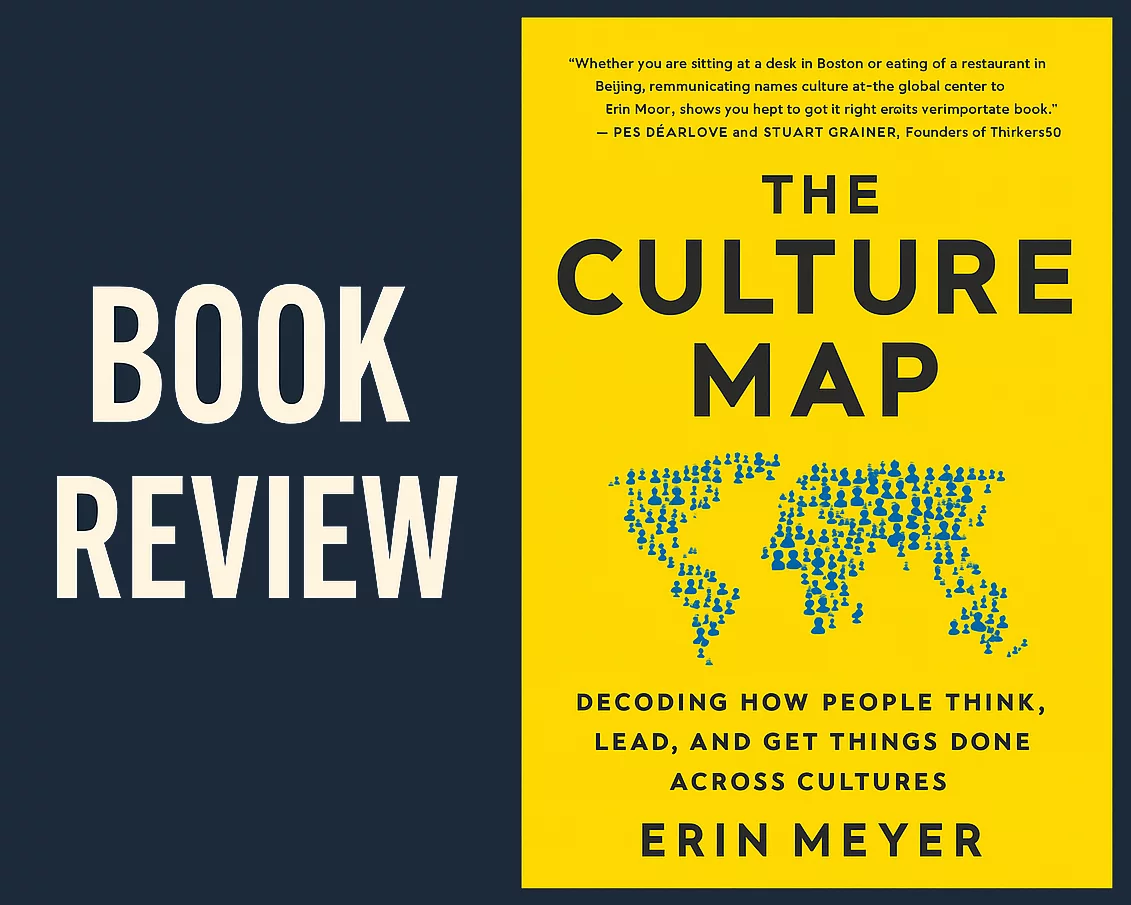
What The Culture Map Taught Me About Cross-Cultural Work and Trust?
Lessons from Erin Meyer's The Culture Map on communication, trust and cross-cultural work, with personal reflections on Slovakia and the Middle East.
 By Ivan Skula
March 31, 2025
By Ivan Skula
March 31, 2025
TL;DR: If you work with people from around the world, The Culture Map by Erin Meyer is well worth your time, especially if you lead a global team or rely on cross-cultural collaboration for success. It reveals how deeply our cultural background shapes how we lead, communicate, and build trust. Ignoring that can lead to misjudgments, miscommunication, and missed opportunities.
Why The Culture Map Was the Right Travel Companion
I usually pack a book or two when I travel, and for our family trip to Japan, I chose The Culture Map by Erin Meyer. It felt like a fitting choice - and a refreshing shift from the communication-focused books I’d been reading and listening to lately. Ironically, I only started reading it on the flight home, but finished it the very next day.

Although I strongly recommend reading the book in full, I’ll share a summary of the main ideas, along with a few personal reflections from my own experience working in a culture different from the one I was born into.
The Eight Scales That Shape Global Collaboration
Erin breaks down cultural differences into eight distinctive dimensions:
- Communicating (low context vs. high context cultures)
- Evaluating (direct vs. indirect negative feedback)
- Persuading (principle-first vs. application-first)
- Leading (egalitarian vs. hierarchical)
- Deciding (consensual vs. top-down)
- Trusting (task-based vs. relationship-based)
- Disagreeing (confrontational vs. avoid confrontation)
- Scheduling (linear-time vs. flexible-time)
While each of us has unique personality traits that influence how we communicate or make decisions, The Culture Map focuses on patterns shared by cultural groups - often shaped by a country’s history, philosophical traditions, religion, and generational norms.
My Cross-Cultural Lessons: Slovakia Meets the Middle East
Coming from Slovakia and having worked in the Middle East for the past 12 years, I've found some differences hard to miss.
In Slovakia, direct negative feedback is quite normal, though it's typically delivered in private. In the GCC, however, it's often better to soften the message and balance it with positive context to preserve harmony and avoid loss of face.
Another notable difference lies in scheduling. In Slovakia, we tend to follow linear-time thinking, though not as strictly as cultures like Germany, Switzerland, or the UK. Deadlines are seen as fixed milestones, and any change is a big deal. In contrast, the GCC operates on a more flexible-time model, where timelines are fluid, and adaptability is expected.
One aspect I used to overlook is how relationship-based cultures are in the Middle East - and much of Asia. In Slovakia, people keep work and personal life separate. Workplace trust is built through performance and consistency. In the Middle East, however, trust is deeply personal - it grows through shared meals, coffee chats, and informal conversations just as much as through formal meetings.
It’s important to note that these observations apply "on average." Company culture can significantly skew some of these dimensions. For example, while Slovakia is shown on Erin Meyer’s “Leading” scale as more hierarchical than egalitarian, the US-based company I worked for in Slovakia had a very flat structure. There was no issue with going directly to the country manager to discuss matters, even without informing your direct supervisor.
Another crucial insight: it’s not a culture's absolute position that matters most, but its relative position compared to yours. We interpret others' actions and communication through the lens of our own cultural norms. Recognizing that lens is the first step to seeing more clearly.
Final Thoughts: What's Water?
One of the most powerful ideas I took from The Culture Map is the reminder that our behaviors - especially at work - are often shaped by the culture we grew up in. These patterns feel so natural, we don’t even notice them.
It’s like the story of the young fish who swims past an older fish who asks, “How’s the water?” The younger one replies, “What’s water?”
Culture is our water.
If we’re unaware of it, we risk misjudging others who are simply doing their best, just in ways shaped by different norms. What might seem disorganized, evasive, rude, or too formal could be someone operating within their own cultural comfort zone and following the rules they’ve learned to obey.
As professionals - especially in global teams or client-facing roles - being aware of cultural preferences doesn’t just help reduce friction; it’s essential.
References & Further Reading
[1] The Culture Map
Author's page for the book and its cross-cultural framework.


