


Fear Not The AI, But The Automation - Your Job Is Next
23.05.2026
In my previous article, I argued that the real threat is not sentient AI but the blind, unchecked automation already woven into our critical systems - scripts doing exactly what they were told, with nobody watching closely enough [1].
This time I want to stay with the same theme but shift from what automation can break to what automation can take. Jobs, to be specific.
Open any newspaper or LinkedIn feed today, and you will find the same story: artificial intelligence is coming for your job. The tone oscillates between breathless excitement and quiet dread. Executives talk about productivity gains. Workers worry about headcount reductions. Consultants sell transformation roadmaps. Everyone is staring at the AI, as if it appeared from nowhere last Tuesday.
It did not.
The conversation we should be having is not "will AI take my job?" but rather "why are we only discussing this now?" Because the job displacement machine has been running for decades. AI is simply its most visible and articulate iteration.
Long before ChatGPT typed a coherent sentence, automation was already reshaping the labor market in ways that barely made the news.
ATMs arrived in the 1960s and spread globally through the 1980s. Bank tellers did not disappear overnight - cheaper branch operations meant banks could open more of them - but the trajectory was clear. Fewer tellers per transaction, every year, forever.
Manufacturing saw it far more brutally. The robotic assembly line hollowed out entire communities built around automotive or textile work. The robots were not intelligent. They welded and stamped and sorted, the same movement, millions of times. No reasoning required.
Then came Robotic Process Automation. Software bots mimicking human clicks inside legacy systems, processing invoices, reconciling accounts, extracting data from forms. Perfectly dumb, spectacularly effective. The RPA market was worth over 13 billion USD in 2023 and continues to grow in the double digits annually [2]. Thousands of back-office roles gone or restructured before anyone mentioned large language models at a board meeting.
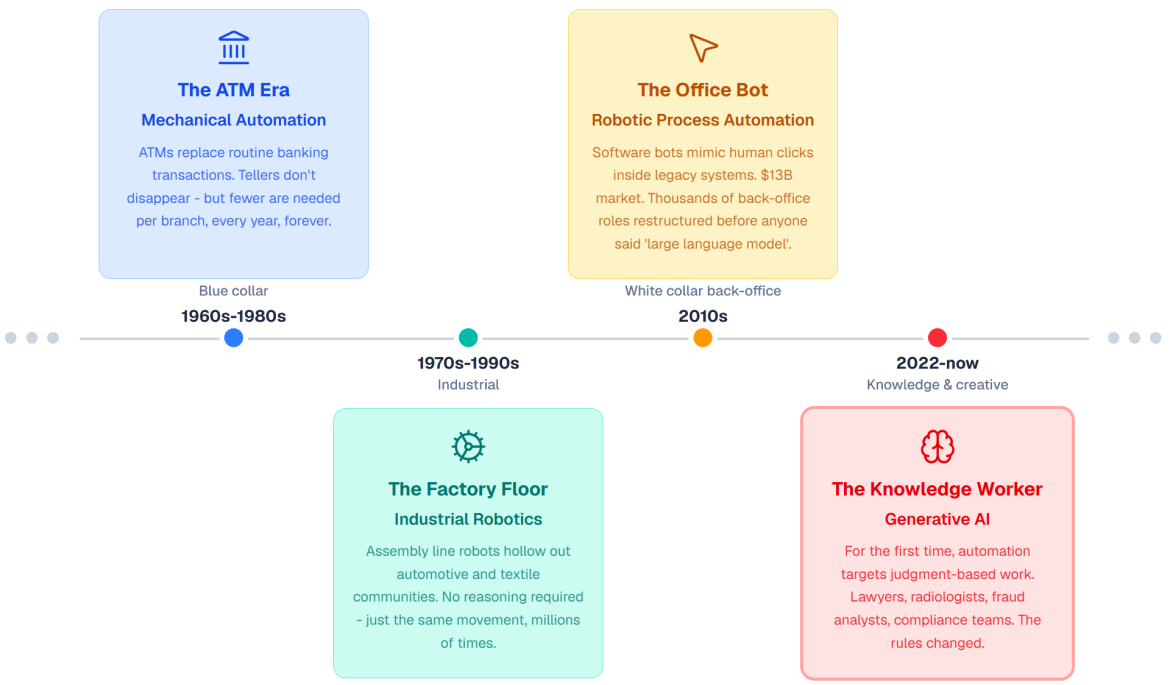
The pattern is consistent. We automate a task. The humans who did it either moved up, moved sideways, or moved out. Rinse and repeat, for sixty years.
So What Is Actually New About AI?
Quite a lot, honestly. But "it is different this time" deserves specifics, not hand-waving. I would like to focus on three particular patterns that set the current wave apart - there are certainly more, but these are the ones worth naming. Two point toward acceleration. One pushes back.
Previous automation waves targeted repetitive, rules-based tasks. Current AI systems target knowledge work, creative work, and professional services. Roles that previously felt safe because they required judgment are now at least partially automatable:
What makes this wave more aggressive is the financial incentive behind it. White-collar workers are expensive. A bank replacing fifty compliance analysts with AI is not making a philosophical statement - it is chasing a specific line item on the cost base. The salary savings from displacing high-earning professionals dwarf anything achieved by automating a warehouse floor. Goldman Sachs estimated that generative AI could expose around 300 million full-time jobs globally to some degree of automation [3]. That is sustained structural pressure, arriving faster than labor markets typically adjust.
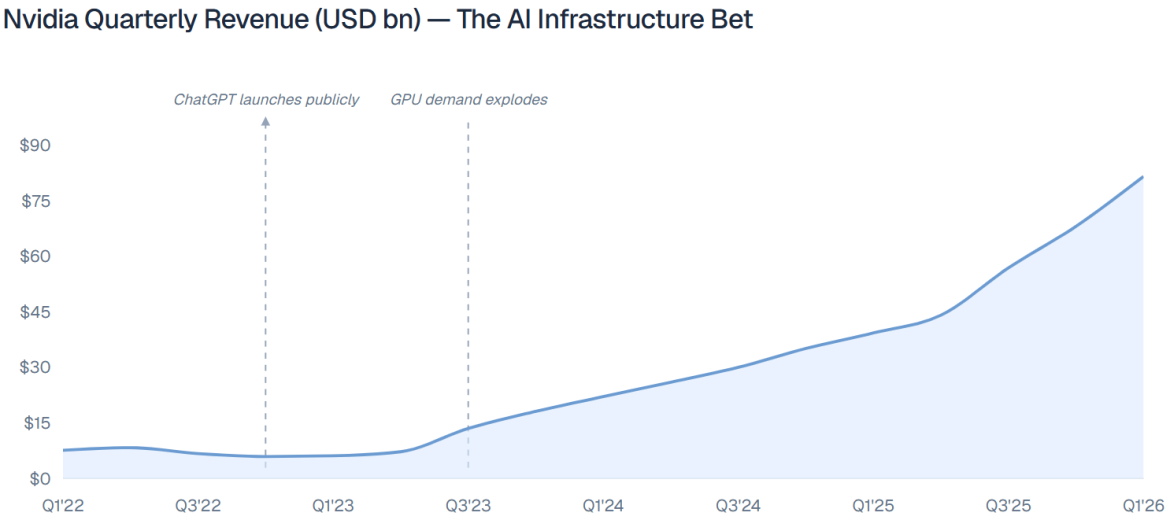
Each model release gets reported in isolation, which obscures how far the curve has moved. On the MMLU benchmark - a standardized test across 57 academic subjects - GPT-3 scored around 35%. By 2025, every frontier model exceeds 88%, and the benchmark is considered functionally saturated [4]. The exam that once separated human experts from machines has been effectively retired because the machines passed it too convincingly (though benchmark contamination is a legitimate caveat - test questions leaking into training data mean models may partially know the answers before sitting the exam).
Current frontier models perform at or above the expert level in roughly half of the over 40 professional occupations tested [5]. Anyone assuming today's limitations are permanent is betting against a very consistent trend.
The clearest signal that a genuine threshold has been crossed came in April 2026, when Anthropic announced Claude Mythos Preview and then declined to release it publicly - not for commercial reasons, but because the model was so capable at finding and exploiting software vulnerabilities that releasing it would put critical infrastructure at risk. The company launched Project Glasswing instead: a restricted consortium of over fifty technology and cybersecurity organizations that use Mythos solely for defensive scanning [6]. In its first month, the model identified over 10,000 high- and critical-severity zero-day vulnerabilities [7]. When an AI company withholds its own product because it is too capable, that is not a PR stunt. It is a data point about where the frontier now sits.
The first is who is being displaced. Every previous wave of automation hit people with limited leverage. The current wave is cutting into the class that matured and pushed forward the internet, understands its mechanics, and is overrepresented on every platform that shapes public narrative. When that group feels threatened, the signal they produce is disproportionate to their numbers. The "AI will destroy everything" volume is not a cross-section of societal anxiety - it is a concentrated output from the people most exposed who happen to own the megaphone. And their pushback will not stop at opinion pieces. Regulatory lobbying with technical credibility, open-source alternatives, and adversarial tooling. Threatened elites with deep technical capability do not go quietly.
The second is the gap between demo and production - and increasingly, between budget forecast and invoice. MIT research found that 95% of enterprise generative AI pilots fail to deliver measurable ROI [8]. S&P Global found that 42% of companies abandoned most of their AI initiatives in 2025, more than double the prior year [9]. Even where adoption succeeds technically, the cost structure is proving brutal. AI platforms charge per token and bill aggressively as usage intensifies. In May 2026, Microsoft revoked internal Claude Code licenses for thousands of engineers after costs spiraled beyond sustainable levels. Uber's CTO revealed the company had burned through its entire annual AI tools budget in just four months [10]. One enterprise consultant reported a client that incurred 500 million USD in AI costs in a single month after deploying licenses without usage controls [11]. And that is before the physical constraints kick in.
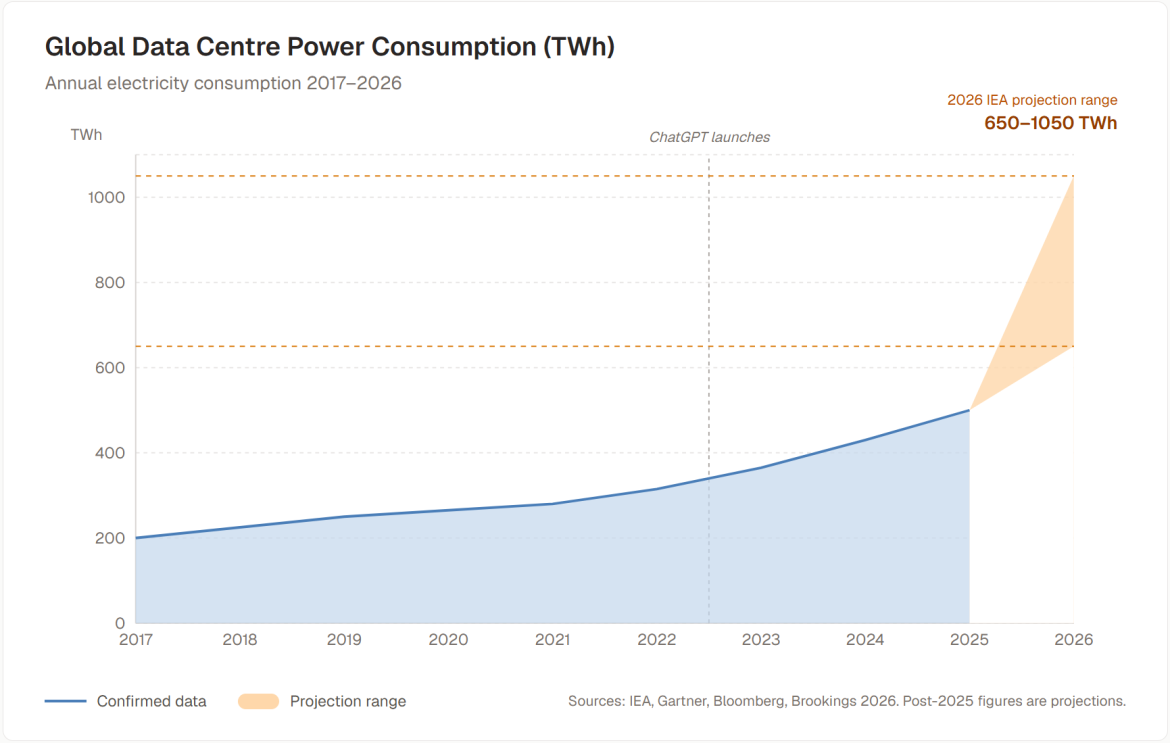
Data centers running AI workloads require 50 to 150 kilowatts per rack, compared with 10 to 15 kilowatts for conventional infrastructure [12]. Transformers and generators are booked years in advance. Raw materials are constrained. Communities are fighting back over water consumption - large facilities use millions of liters daily - and over diesel generators bridging grid shortfalls. The social license to build more capacity is eroding alongside the financial one.
The third is the accuracy ceiling in high-stakes domains. Retrieval-Augmented Generation - the most common entry-level enterprise AI deployment, sold as the fix for hallucination - still fabricates between 5 and 7% of answers under realistic conditions, with the best recorded result being 1.19% under optimal ones [13]. In fraud detection or financial crime investigation, a 5% fabrication rate is not a quirk to manage. It is either a false SAR narrative or a missed typology match awaiting regulatory review. Until that problem is structurally solved, there is a hard ceiling on how far AI can displace human judgment where accuracy is a requirement rather than a preference - and that ceiling is lower than the vendor pitch decks suggest.
The direction of travel is clear. The timeline is less certain than the coverage implies.
It would be convenient to assume that fraud and financial crime work sits safely above this. The work is complex, contextual, adversarial. Fraudsters adapt, so surely the analyst must too.
Partly true. But consider what fraud operations actually involve at the task level:
Every one of those tasks is now being targeted by AI tooling. Alert triage platforms have been reducing analyst workload for years. Generative AI is being applied to SAR drafting. Graph analytics automates relationship mapping that analysts previously did manually across spreadsheets.
There is, however, a structural protection that fraud and compliance professionals have which most other knowledge workers do not: regulators require human accountability. Financial intelligence units, AML supervisors, and AI governance frameworks do not accept "the model decided" as a defensible position. A SAR filed on the basis of an AI recommendation still needs a human to own it. The EU AI Act and emerging equivalents in the Gulf are hardening the human-in-the-loop requirement for high-risk automated decisions, which financial crime squarely qualifies as.
This does not mean headcount is safe. Nobody is saying there must be many humans in the loop - only that there must be some. The practical implication is that AI will compress team sizes while concentrating accountability on a smaller number of more senior specialists who can own the decisions the model surfaces. The volume of junior analyst roles will shrink. Demand for professionals who understand both the typology and the tooling well enough to challenge and override AI outputs will grow. A different shape of the market, not an empty one.
For those working at the intersection of fraud and cybersecurity, Mythos adds a sharper edge. A model capable of autonomously weaponizing software vulnerabilities in banking systems and payment networks could equally automate the sophisticated end of financial crime in the wrong hands. Back in 2023, I wrote about the then-emerging threat of AI-automated vishing - replacing human call center agents in fraud operations with LLMs that could converse with victims at unlimited scale and zero marginal cost [14]. What was a warning then is now an operational reality for more sophisticated fraud rings. The dual-use nature of these tools is already the reason Anthropic is restricting access to a model it built itself.
The fraud analyst of 2030 will not disappear. They will look very different from the fraud analyst of 2015, manage a higher-complexity workload, and there will probably be fewer of them doing the same volume of work. That is the same pattern the bank teller lived through, just arriving faster.
The instinct when facing this kind of pressure is either to dismiss it or to catastrophize. Both are unhelpful.
Dismissal sounds like: "AI cannot replicate human judgment." True in edge cases. Insufficient as a career strategy when AI handles 80% of routine volume and humans are needed only for the genuinely complex 20%.
Catastrophizing sounds like: "There will be no jobs left." Previous automation waves created new roles, and this wave will almost certainly create new ones as well. But whether in sufficient numbers, at sufficient speed, and accessible to the people displaced is genuinely harder to predict this time - precisely because this wave is structurally different from the ones before it. The more honest and immediately useful framing is this: you will not be replaced by AI, but you may well be replaced by someone who uses AI better than you do. That is likely to remain true for at least the next several years, and it is a problem with a practical solution.
Clarity looks like an honest audit:
We should stop talking about AI as if it arrived uninvited and started the problem. It is the latest chapter in a story that began with the industrial loom, continued through the ATM, the assembly-line robot, and the RPA bot, and is now entering a phase in which knowledge work is on the table.
The AI is not the villain. It is also not irrelevant. It is an accelerant, arriving on a road that was already going somewhere.
The honest question is not whether automation will change your job. It will, or it already has. The honest question is whether you are paying attention to the direction of travel or still waiting to be surprised.
As of late 2025, only 1 in 5 workers reports using AI in their job in any capacity [15] - and Gallup puts it even more starkly: nearly half the workforce has never used AI in their role at all [16]. The technology reshaping the labor market is, for most people, still something they read about rather than something they use. Make of that what you will.
[1] Skula, I. "Fear Not The AI, But The Automation." LetsTalkFraud.com, April 2025.
[2] Grand View Research. Robotic Process Automation Market Size, 2023.
[3] Goldman Sachs. "The Potentially Large Effects of Artificial Intelligence on Economic Growth." March 2023.
[4] Kili Technology. "AI Benchmarks 2026: Top Evaluations and Their Limits." May 2026.
[5] OpenAI. "Introducing GPT-5." August 2025. openai.com/index/introducing-gpt-5
[6] Anthropic. "Project Glasswing: Securing critical software for the AI era." April 7, 2026. anthropic.com/glasswing
[7] CybersecurityNews. "Anthropic's Claude Mythos Preview Uncovers 10,000+ 0-Days in Project Glasswing." May 2026.
[8] MIT NANDA Initiative. "The GenAI Divide: State of AI in Business 2025."
[9] S&P Global / Beam.ai. "Why 42% of AI Projects Show 0 ROI." April 2026.
[10] Fortune. "Microsoft reports are exposing AI's real cost problem." May 2026. fortune.com
[11] AI Weekly. "Microsoft drops Claude Code as enterprise AI ROI fails." May 2026. aiweekly.co
[12] AInvest. "Building the AI Infrastructure S-Curve: The 2026 Investment Playbook." January 2026.
[14] Skula, I. "The Dawn of the Vishing." LetsTalkFraud.com, November 2023.
[15] Pew Research Center. "About 1 in 5 U.S. Workers Now Use AI in Their Job." October 2025. pewresearch.org
[16] Gallup. "Frequent Use of AI in the Workplace Continued to Rise in Q4." January 2026. gallup.com